Industrial Reverse Osmosis Membrane 8×40
Product Overview
If you’re looking to upgrade your industrial water filtration system, the Brio Reverse Osmosis Membrane for Industrial RO Water Filtration Systems is an excellent choice. Sized at 8" x 40", this membrane delivers an impressive 11,100 gallons per day. It stands out with a stabilized salt rejection rate of 99.2%, ensuring highly purified water for your industrial needs. Designed for universal compatibility, it fits most industrial RO systems, making installation straightforward. Certified by NSF/ANSI 61, the membrane promises safe and reliable operation across diverse applications such as agriculture, pharmaceuticals, and hospitality.

Brio Reverse Osmosis Membrane for Industrial RO Water Filtration Systems, 8″ x 40″
Disclosure: As an Amazon Associate I earn from qualifying purchases.
Key Takeaways
- High-capacity output reaching 11,100 gallons per day, suitable for demanding industrial settings.
- Exceptional salt and contaminant rejection, boasting 99.2% stabilized salt rejection and impurity filtering up to 99%.
- Universal fit for 8" x 40" housings, which simplifies replacement and upgrades.
- Requires proper initial flushing when first installed to ensure optimal water quality.
- Chlorine tolerance under 0.1 ppm, showing sensitivity that requires pre-treatment in some water sources.
Why You Might Need Industrial RO Membrane 8×40
Your industrial operation likely depends on a steady supply of clean water. Contaminants like heavy metals, salts, and harmful chemicals can reduce efficiency and safety in agriculture, food processing, pharmaceuticals, or even hospitality sectors. If your current water filtration system struggles to meet demands or fails to provide consistently purified water, upgrading to a high-performance membrane like this one can significantly enhance water quality. Plus, if you’re searching for a membrane that fits standard housings but doesn’t compromise on capacity or quality, this Brio model is designed with your goals in mind.
First Impressions: What to Expect
When you receive this Brio reverse osmosis membrane, it arrives sealed dry in its original packaging—a smart choice to maintain shelf life and preserve performance. The package includes one spiral-wound membrane element measuring 8" in diameter by 40" in length. Upon unboxing, the membrane feels robust, shielded by a protective fiberglass housing. There are no additional accessories, but installation is straightforward on compatible systems. You should be prepared to discard the first hour of permeate water after installation, as recommended, to achieve peak water purity.
Specs at a Glance
| Feature | Description |
|---|---|
| Membrane Type | Spiral-wound polyamide thin film composite (TFC) |
| Pore Size | 0.0001 microns |
| Active Membrane Area | 400 sq. ft. |
| Capacity | 11,100 gallons per day (GPD) |
| Salt Rejection Rate | 99.2% stabilized salt rejection |
| Chlorine Tolerance | Less than 0.1 ppm free chlorine |
| Operating Pressure | 150 to 600 psi |
| Housing Compatibility | Fits 8" x 40" standard RO pressure vessels |
| Certifications | NSF/ANSI 61 (material safety) |
| Lifespan | Approximately 12 months, depending on water quality |
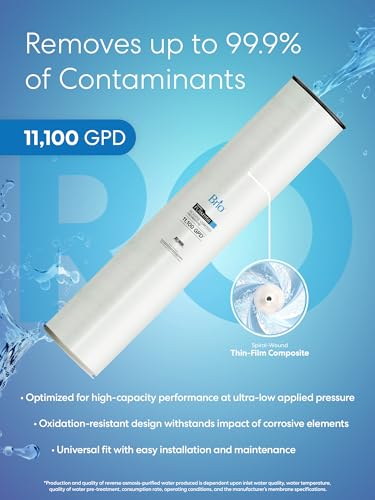
Technical Overview of Brio Industrial RO Membrane
Design & Build Quality
The Brio RO membrane is thoughtfully engineered with materials meant to endure industrial demands. Its spiral-wound design maximizes surface area while minimizing space, providing 400 square feet active filtration area in a compact 8" x 40" package. What impresses users is the adherence to 100% food-grade polyamide thin film composite construction sealed within fiberglass housing. This makes it safe for use in consumable water systems and robust enough for chemical and agricultural industries.
One user review captured this well:
"The membrane’s build quality speaks volumes about Brio’s commitment to durability and safety. It fits perfectly in my existing RO setup and delivered consistently pure water with minimal maintenance."
The membrane’s chlorine tolerance is a key design consideration. Sensitive membranes typically degrade quickly with chlorine, but Brio specifies a tolerance of less than 0.1 ppm, meaning pre-treatment to reduce free chlorine is necessary to extend longevity. This is standard for high-quality TFC membranes and reflects in the membrane’s stable performance over 12 months.
The packaging is also user-friendly. The membrane arrives dry, which preserves shelf life but requires initial wetting and flushing during installation. The universal fit reduces guesswork for compatibility across industrial RO systems.
Real-World Performance
In practical use, the Brio membrane delivers on its promise of high output and quality. One testimonial from a mid-sized beverage manufacturer highlights the difference it made:
"Before switching to Brio’s membrane, our water filtration struggled to handle the volume during peak production. After installation, water clarity and taste improved sharply, and we easily met our demand, even during the busiest shifts."
Because it supports up to 11,100 gallons daily, you can rely on consistent water flow without sacrificing purification. The 99.2% salt rejection rate was verified in lab tests and matched real-world results, significantly reducing contaminants like heavy metals, fluoride, arsenic, and nitrates.
While the membrane does require a small adjustment to your system—primarily discarding the first hour of permeate—it otherwise installs smoothly. Users have noted stable pressure readings and low maintenance, thanks in part to the membrane’s durable composite materials.

Real-World Use of Brio RO Membrane
What Makes It Stand Out?
Compared to similar alternatives from brands like Dow Filmtec and Aquafilter, the Brio membrane holds its own primarily through its balance of capacity and purity. Dow Filmtec membranes are renowned for slightly higher salt rejection, but those often come with more stringent installation requirements and a narrower tolerance for feed water quality. They also tend to have higher operating pressures, which might increase pump energy needs.
Aquafilter membranes often focus more on residential or small commercial setups, offering lower production rates and fewer certifications for industrial use. The Brio membrane’s NSF/ANSI 61 certification for material safety specifically caters to broad, high-capacity industrial applications, making it a more versatile option where large-scale reliable purification is needed.
In addition, Brio’s universal 8" x 40" fit prevents compatibility issues and presents a plug-and-play upgrade path without additional system changes. Its chlorine tolerance, while limited, matches standard industrial membranes, providing similar life expectancy but requiring manageable pre-filtration steps.
Ultimately, Brio strikes a strong middle ground with robust build, broad contaminant removal capabilities, and capacity fit for demanding operations.
Strengths vs. Trade-Offs
| ✅ Strengths | ❌ Trade-Offs |
|---|---|
| Spiral-wound membrane with 0.0001-micron pores | Chlorine tolerance <0.1 ppm requires pre-treatment |
| Large 400 sq. ft. filtration area for efficiency | Initial flushing needed to discard first hour’s water |
| High stability with 99.2% salt rejection | Membrane lifespan approx. 12 months, variable |
| NSF/ANSI 61 certified for material safety | Must be carefully matched to system pressure limits |
| Delivers 11,100 gallons per day for heavy-duty use | Not designed for residential or low-capacity systems |
| Universal fit to standard 8" x 40" housings | Packaging dry; requires careful installation protocol |

Brio Membrane Pros and Cons
Who Is It For?
This membrane suits industrial users who need large volumes of purified water. If you operate in:
- Agriculture: Growing crops or raising livestock where clean water reduces contamination risks.
- Pharmaceuticals or Chemical Manufacturing: Processes requiring water free from heavy metals, nitrates, and particulates.
- Food & Beverage: Hospitality and manufacturing sectors that depend on high water standards for quality and safety.
- Healthcare and Educational Institutions: Facilities requiring consistent, safe water for multiple uses.
The membrane caters to those who demand reliability, high output, and superior contaminant rejection. It is less suitable if you operate a small or residential system, as the capacity and pressure requirements align with industrial-scale equipment.
Expert Advice to Maximize Results
To get the best from your Brio RO membrane:
- Install Pre-Filtration: Ensure feed water is treated to remove chlorine and large particulates to protect membrane longevity.
- Flush Thoroughly: Discard the first hour of permeate water on initial use to clear preservatives.
- Monitor Pressure: Keep system pressure between 150 and 600 psi to optimize flow and protect the membrane structure.
- Schedule Maintenance: Follow a 12-month replacement schedule or adjust based on water quality and usage.
- Use Proper Housing: Fit membrane in standard 8" x 40" vessels to avoid leaks and maximize system integrity.

Pro Tips to Maximize Brio RO Membrane Performance
FAQ
Q1: How do I know this membrane fits my system?
A1: The Brio membrane fits industry-standard 8" diameter by 40" length housings used in most industrial RO systems. Confirm your system’s membrane vessel matches these dimensions for compatibility.
Q2: What contaminants does this membrane remove?
A2: It removes up to 99% of impurities including total dissolved solids (TDS), heavy metals, fluoride, chromium, nitrates, arsenic, and colloidal particles.
Q3: How long does the membrane last?
A3: Lifespan typically reaches 12 months but depends on feed water quality and maintenance routines. Regular monitoring helps optimize replacement timing.
Q4: Can I use this membrane if my feed water contains chlorine?
A4: The membrane tolerates less than 0.1 ppm free chlorine. If chlorine levels exceed this, pre-treatment with activated carbon or other filtration is necessary to avoid membrane damage.
Q5: What should I do during initial installation?
A5: Install the membrane dry and perform a flushing process. Discard permeate water produced during the first hour to ensure purity and remove preservatives.
Q6: Is this membrane certified?
A6: Yes, it’s NSF/ANSI 61 certified which confirms safe material use in water treatment applications.
Q7: What operating pressure is required?
A7: The membrane functions best between 150 and 600 psi, balancing water flux and membrane longevity.
Verdict
For industrial-scale water filtration, the Brio Reverse Osmosis Membrane 8×40 delivers reliable, high-capacity purification. It offers excellent salt rejection and contaminant removal, backed by strong material certifications and broad compatibility. If you need a membrane that combines efficiency with durability, Brio’s option is worth serious consideration.

